How does the brain generate the behavior we need right now?
We seek warmth when cold and drink when thirsty. We respond differently to someone we have just met and someone we know. Behavior depends on more than the stimulus in front of us: it also depends on what the body needs and what we have experienced.
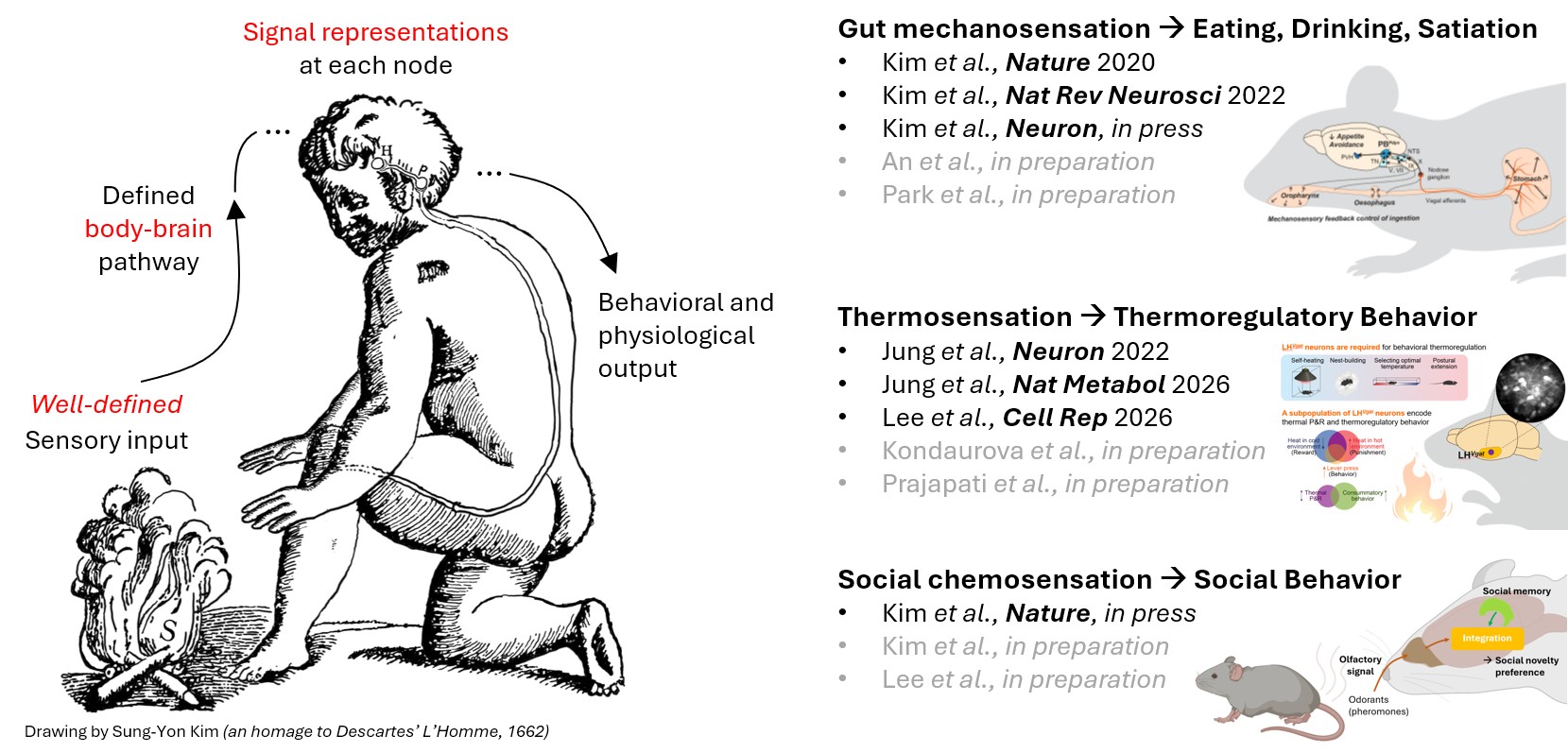
The Neural Circuit Lab at Seoul National University studies how sensory signals from inside and outside the body, internal state, and memory are processed by neurons and synapses to shape behavior and physiology. By algorithms, we mean biological rules for operations such as comparing signals, changing their influence, and accumulating information over time. We test these rules by precisely measuring sensory inputs and behavior in mice and manipulating the circuits that connect them.
Recent discoveries
How does the brain recognize a stranger?
Novelty is not a fixed property of another individual. It depends on past experience. In mice, we identified a circuit that combines social odors with familiarity-related memory signals to guide greater investigation of unfamiliar animals. Suppressing selected pathways removed the preference for strangers while preserving general social interest. This reveals how sensory information acquires behavioral meaning through memory.
Nature | Accepted. Explore the discovery
Why does thirst ease before water has been absorbed?
Drinking eases thirst within seconds, yet it takes longer for water to be absorbed and restore the body’s fluid balance. How does the brain respond before that recovery? In mice, we identified a pathway through which pressure in the throat during swallowing rapidly inhibits thirst neurons. The circuit produces strong inhibition when swallows arrive in rapid succession, as they do during drinking. By responding to the timing of these signals, the circuit rapidly reduces thirst drive and helps bring a drinking bout to an end.
Neuron | Accepted. Explore the discovery
How does the whole body respond to cold?
Defending against cold requires heat production, shivering, warmth seeking, and increased energy intake. We identified a cold-responsive brainstem population in mice that orchestrates these diverse adaptations. The findings reveal how sensing cold coordinates changes in physiology, metabolism, behavior, and reward responses.
Nature Metabolism | Published 2026. Read the paper
Trainees turn questions into discoveries
Students and postdocs at the Neural Circuit Lab help lead the full research process: shaping questions, designing experiments, interpreting results, and communicating discoveries in papers.
Sieun Jung co-led our studies of thermoregulation as a co-first author of papers in Neuron (2022) and Nature Metabolism (2026) and is now a postdoctoral researcher at UCSF. Dong-Yoon Kim, a co-first author of our Nature study of ingestion feedback (2020), is continuing postdoctoral research at Rockefeller University as an HFSP Fellow. Minyoo Kim and Dong-Jun Koo, co-first authors of our thirst-satiation study accepted for publication in Neuron, are now postdoctoral researchers at Yale University and the Monell Chemical Senses Center, respectively.
Our team brings together postdoctoral researchers, graduate students, and research support staff from different academic backgrounds. Meet the people behind our research and learn about their paths.
Meet our team and alumni | About Sung-Yon Kim
Bring your questions to our lab
We welcome inquiries about graduate study, undergraduate research, and postdoctoral opportunities. Email Sung-Yon Kim with a brief introduction, your current affiliation, the questions that interest you, and when you would like to join: sungyonkim@snu.ac.kr
News and talks
Follow us on Instagram for our latest publications, lab news, and glimpses of everyday life in the lab. On X/Twitter, we share recent papers and lab updates with the global scientific community. You can also watch public lectures and research presentations by Sung-Yon Kim on YouTube.
Sung-Yon Kim discusses optogenetics and brain research on Unrealscience, a Korean popular science channel.
How can controlling neurons with light help us understand how the brain works? Sung-Yon Kim joins host Hangseong to discuss optogenetics and brain research. Watch the video
_


Address and contact
Neural Circuit Lab
Institute of Molecular Biology and Genetics, Seoul National University
Building 105, Room 209
1 Gwanak-ro, Gwanak-gu, Seoul 08826, South Korea
Phone: +82-2-880-4996